
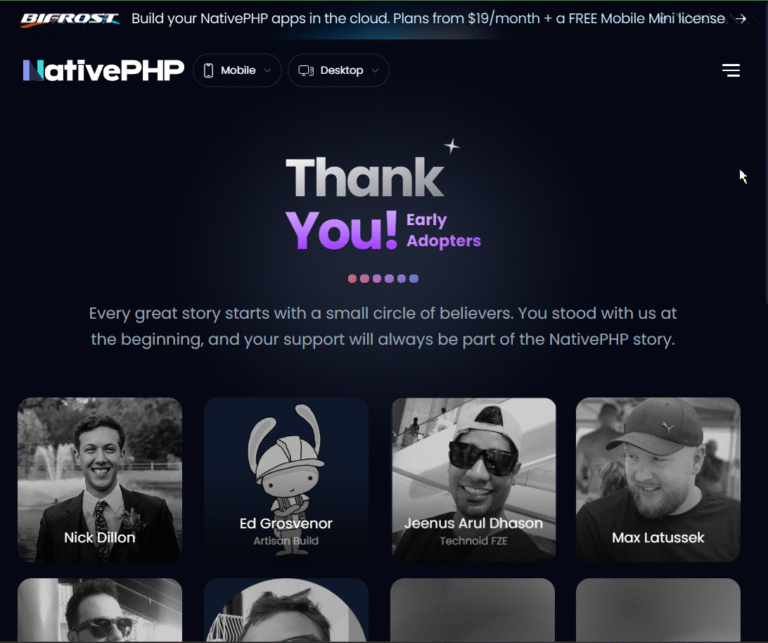
Year: 2025

Join the NativePHP Wall of Love — Jeenus

As developers, we’ve all had that moment — the thrill of seeing our ideas come to life. But until recently, building mobile or desktop apps meant stepping outside our comfort zone — switching stacks, learning new frameworks, or relying on Electron wrappers that never quite felt native. That’s where NativePHP changes the game. It brings…

Improving Laravel Deployment Strategies

When it comes to deploying Laravel applications, having a solid strategy in place can make a world of difference. In this post, we’ll discuss some tips for improving your Laravel deployment strategies. 1. **Optimize Your Application**: Before deploying your Laravel application, it’s essential to optimize it for production. This includes running `composer install –optimize-autoloader –no-dev`…

Optimizing Laravel Routes for Better Performance

Are your Laravel routes optimized for better performance? Here are some tips to make sure your routes are running efficiently: 1. Use Route Caching: To improve the performance of your Laravel application, you can cache your routes using the `route:cache` Artisan command. This will combine all of your route registrations into a single file, reducing…

Efficient Database Management Techniques in Laravel

Database management is a crucial aspect of any web application, especially when using a framework like Laravel. In this post, we will discuss some efficient database management techniques that can be used in Laravel to improve performance and maintainability. 1. Use Eloquent ORM: Laravel’s Eloquent ORM makes database management a breeze by providing a simple…

Improving User Authentication in Laravel

User authentication is a crucial aspect of any web application, and Laravel provides a powerful authentication system out of the box. However, there are certain tips and best practices that can help you improve the user authentication process in your Laravel application. 1. Use Multi-Factor Authentication (MFA): Implementing multi-factor authentication adds an extra layer of…

Laravel Tips: Streamlining Your Application’s Middleware Execution

Are you looking for ways to streamline your application’s middleware execution in Laravel? Middleware plays a crucial role in the request-response cycle of your application, allowing you to filter HTTP requests entering your application. In this post, we will share some tips on how to optimize and manage middleware in your Laravel application. ### Tip…

Laravel Performance Optimization: Practical Tips — Jeenus

Are you looking to optimize the performance of your Laravel application? In this post, we will share some efficient tips and tricks to help you boost the performance of your Laravel application. 1. Use Eager Loading: One common performance issue in Laravel is the N+1 query problem. To avoid this, make use of eager loading…

Mastering Advanced Laravel Eloquent Techniques

Are you looking to level up your Laravel skills and become a master of advanced Eloquent techniques? In this post, we will explore some tips and tricks to help you take your Laravel Eloquent skills to the next level. ### 1. Query Scopes Query scopes allow you to define reusable sets of constraints for your…

Optimizing Laravel Queries for Better Performance

Here are some tips to optimize Laravel queries for better performance: 1. **Use Eager Loading**: Instead of lazy loading relationships, eager loading helps reduce the number of queries executed. You can use the `with()` method to eager load relationships. 2. **Indexing**: Make sure to index the columns frequently used in where clauses to speed up…

Optimizing Eloquent Relationships in Laravel — Performance Tips

When working with Laravel, optimizing eloquent relationships is essential for better performance of your application. In this post, we will explore some tips and best practices to enhance the performance of eloquent relationships in Laravel. 1. Eager Loading: Eager loading is the process of fetching the related models of a relationship in a single query,…