
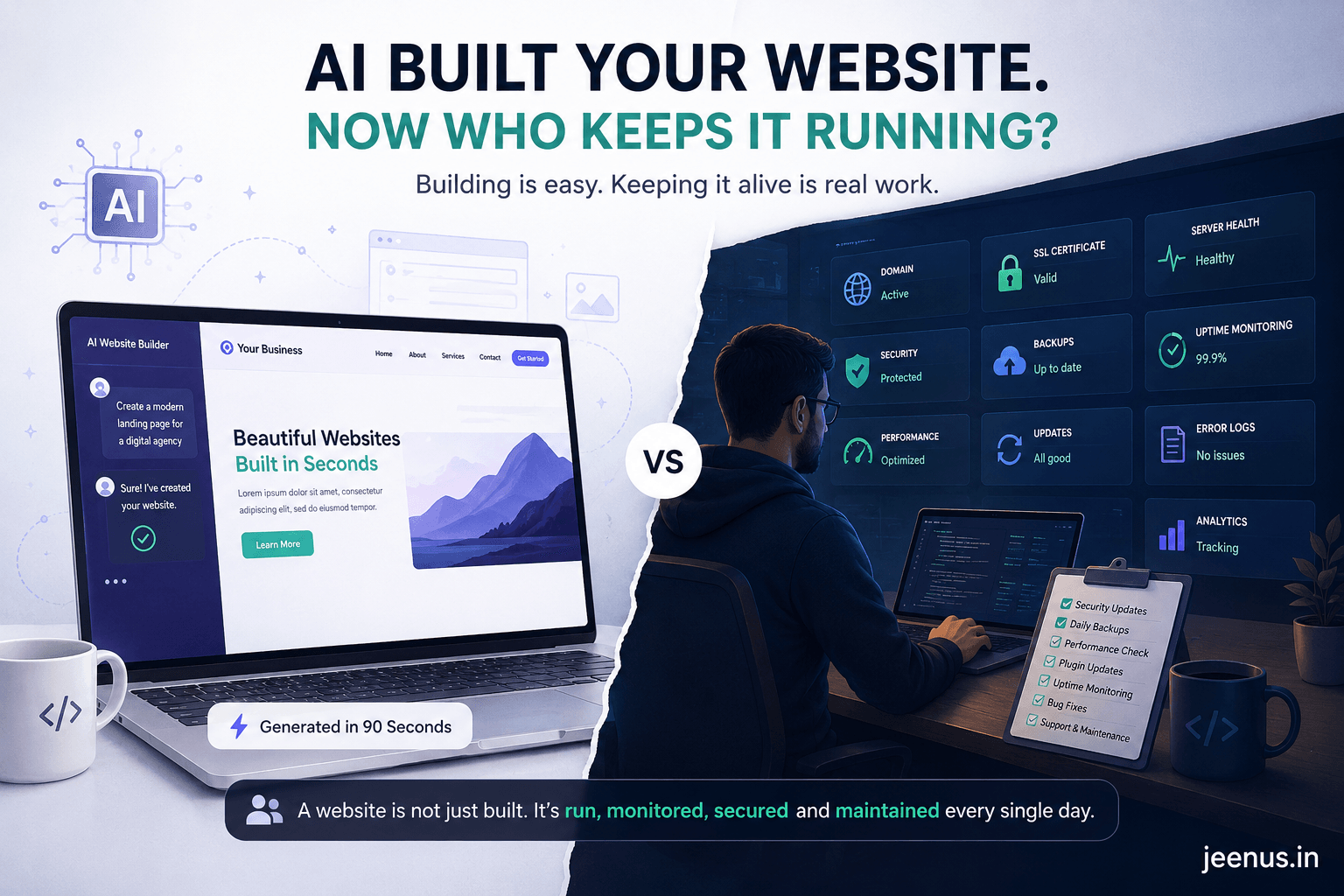
AI Built Your Website. Now Who’s Going to Keep It Alive?
Scroll through LinkedIn or X for five minutes and you’ll see the same video over and over.
Someone types a prompt into an AI tool.
Ninety seconds later, a polished landing page appears.
The caption usually says something like:
“Why pay an agency $10,000 when AI can build your website?”
The demo gets millions of views.
The comments fill with people declaring that developers are finished and agencies are dead.
As someone who has spent years building and maintaining production systems, I don’t think those people are wrong about AI.
I think they’re measuring the wrong thing.
Building a website was never the difficult part.
This is the part almost nobody talks about.
Creating pages, writing HTML, generating components, styling interfaces…
Those haven’t been the expensive parts of software for a long time.
First we had templates.
Then WordPress.
Then Shopify.
Then Elementor.
Then Webflow.
Now AI.
Every generation has made building cheaper.
But businesses weren’t paying agencies just to write code.
They were paying for everything that happens after the code exists.
That’s the part AI demos never show.
Every AI demo ends at exactly the same moment.
The website renders.
The presenter smiles.
Video ends.
Congratulations.
You have a website running on localhost.
One visitor.
Zero customers.
Zero real traffic.
Now let’s talk about Monday morning.
Reality starts after the demo.
Your contact form looks perfect.
Except every enquiry is landing in spam because SPF, DKIM and DMARC were never configured correctly.
Three weeks later the client says,
“We’re getting no leads.”
The website wasn’t broken.
The business was.
Your payment gateway works perfectly…
…until the provider changes their API.
Webhooks start failing.
Customers pay.
Orders don’t update.
Support tickets begin arriving before anyone notices.
Your AI-generated website loads in under a second.
Then your marketing campaign finally succeeds.
Five hundred people visit at once.
The server crashes because nobody tested concurrency, caching, queues or scaling.
Ironically…
The website fails because the business became successful.
A package introduces a security vulnerability.
An SSL certificate expires.
A domain renewal email goes unnoticed.
A backup has never actually been tested.
A DNS record is accidentally deleted.
Google Search Console starts reporting hundreds of errors.
Analytics quietly stop tracking conversions.
A plugin update breaks checkout.
A dependency ships a breaking release.
These aren’t rare edge cases.
They’re Tuesday.
Ask anyone who’s maintained production systems for a few years.
Every single one has stories that begin with:
“The client built it themselves…”
AI answers questions.
It doesn’t know which questions you forgot to ask.
That’s the difference.
AI is extraordinary at solving the problem you present.
But it won’t tell you that your deployment strategy has three hidden risks.
It won’t ask why your backups have never been restored.
It won’t warn you that your email reputation is collapsing.
It won’t wake up at 2:17 AM because monitoring detected elevated error rates.
It won’t notice memory slowly leaking over six weeks.
It won’t remind you that your DNS TTL should have been reduced before migration.
Because you didn’t ask.
And that’s exactly the problem.
Experience isn’t knowing the answers.
Experience is knowing the questions.
A website is not a product.
It’s an operating system for your business.
If your website generates revenue…
Collects customer data…
Processes payments…
Books appointments…
Captures leads…
Integrates with CRMs…
Connects to ERPs…
Synchronizes inventory…
Sends emails…
Runs automations…
Uses third-party APIs…
Then you don’t own a website anymore.
You own a production system.
Production systems need maintenance.
Monitoring.
Updates.
Backups.
Testing.
Documentation.
Recovery plans.
Security reviews.
Performance optimisation.
Compliance.
Ownership.
None of those disappear because AI wrote the first version.
Let’s also be fair.
AI is incredible.
I use it every day.
Our team uses it every day.
It has made us dramatically faster.
If you’re building:
a personal portfolio
a restaurant landing page
an event website
an MVP
an internal dashboard
a proof of concept
Use AI.
Seriously.
You’ll save time and money.
Not every project needs an agency.
Not every project needs a developer.
But here’s the question that matters:
What happens if this website goes down tomorrow?
If the answer is:
“Nothing important.”
Build it with AI.
If the answer is:
“We stop making money.”
Then you’re no longer solving a website problem.
You’re solving an operational problem.
Those are very different things.
The value has shifted.
AI didn’t eliminate developers.
It eliminated repetitive development.
That’s a good thing.
Developers should spend less time writing boilerplate and more time solving business problems.
The same is true for agencies.
Good agencies aren’t competing against AI.
They’re using AI.
The value is no longer in writing another login page.
The value is:
designing reliable architectures
planning deployments
integrating complex systems
securing applications
monitoring production
reducing downtime
recovering from failures
making technology support business growth instead of blocking it
In other words…
The code became cheaper.
The responsibility became more valuable.
The most expensive website you’ll ever own…
…isn’t the one that cost $20,000.
It’s the one that cost $200 to build…
…and then quietly loses customers, rankings, emails, sales and trust because nobody was responsible for keeping it alive.
AI can generate a website.
It cannot own the outcome.
And that’s the difference between shipping code…
…and running a business.
The future isn’t AI versus developers.
It isn’t AI versus agencies.
The smartest companies are already doing something else.
They use AI for speed.
They use experienced people for judgement.
Because when production breaks at 2 AM, nobody cares how quickly the homepage was generated.
They care about one question:
“Who’s accountable for getting us back online?”
That’s a question no prompt can answer.